
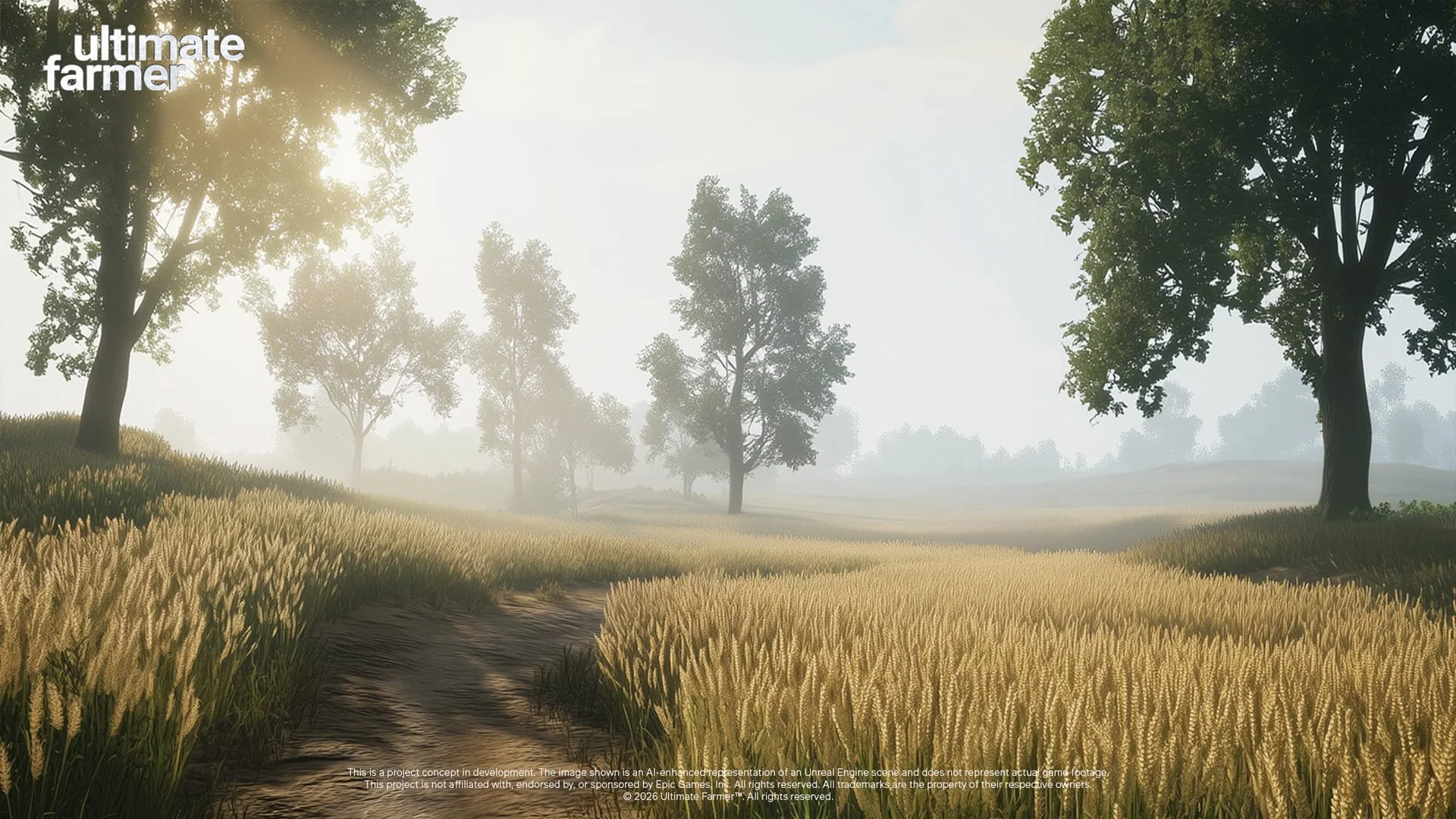

Concept Reference ← → Development Build
(slide me)
The first environments published as part of Ultimate Farmer were created during the earliest stages of pre-production, before landscape development, environmental systems, and world-building workflows had entered active development.
At that stage, the project already had a growing Game Design Document, gameplay concepts, technical research, and long-term production objectives. What remained unresolved was how those ideas would translate into an actual game world.
Open-world farming environments can vary significantly. Terrain profiles, field layouts, vegetation density, visibility distances, road networks, atmosphere, and environmental scale all influence both the visual identity of a landscape and the technologies required to support it. Decisions made during this stage affect everything from level design and optimisation to vegetation workflows and world composition.
To evaluate these variables before committing development resources, a series of Unreal Engine style CGI concept environments were created as part of the project's visual development process.
Exploring Environmental Direction
Landscape production is one of the most resource-intensive aspects of open-world game development. Once terrain systems, road networks, vegetation placement, and environmental assets enter production, significant directional changes become increasingly costly.
The concept environments provided a practical way to evaluate different approaches before reaching that stage.
A wide range of environmental characteristics were explored, including terrain variation, field composition, vegetation density, visibility distances, weather conditions, seasonal atmosphere, and landscape scale. Each concept acted as a visual prototype, allowing different environmental approaches to be compared and assessed against the project's objectives.
This process helped establish several priorities that continue to influence development today.
Completely flat landscapes were gradually deprioritised in favour of environments featuring rolling terrain, varied elevations, woodland boundaries, and more organic field layouts. Greater emphasis was placed on environmental depth, layered vegetation, atmospheric conditions, and natural transitions between agricultural and undeveloped areas.
Rather than defining individual locations, the concepts helped identify the characteristics that consistently produced more believable and visually distinctive countryside environments.
Establishing Environmental Benchmarks
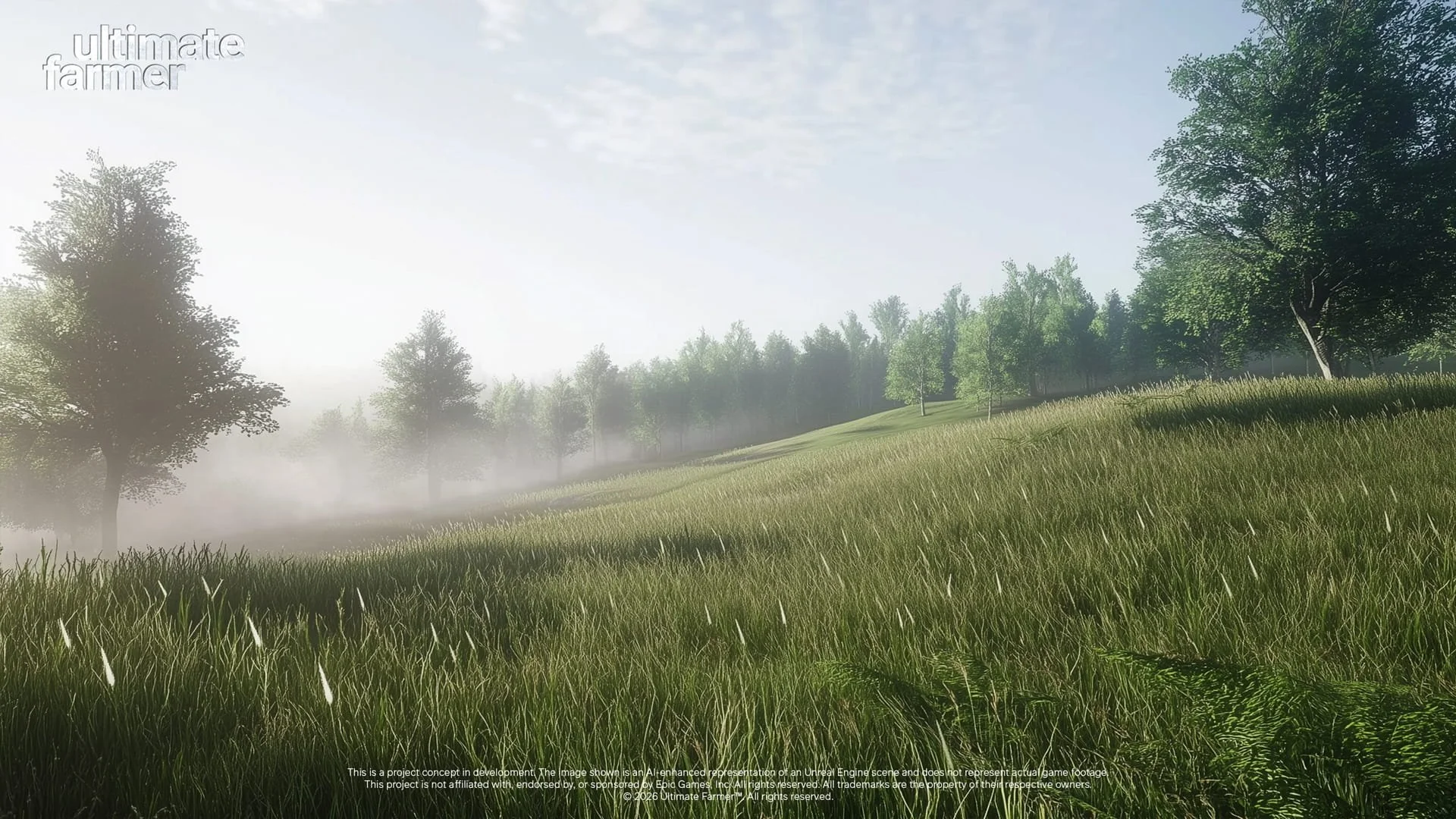

Concept Reference ← → Development Build
(slide me)
The concepts also provided a shared framework for evaluating design decisions.
Terms such as realism, atmosphere, immersion, scale, and authenticity can mean different things to different people. Visual references make those discussions more productive by providing something tangible to analyse and compare.
Instead of relying entirely on written descriptions, environmental goals could be assessed through actual landscapes. Terrain composition, visibility, vegetation density, environmental variety, and overall world structure could all be evaluated against the intended direction of the project.
This helped establish a clearer set of environmental benchmarks that could later be applied to development builds, technical prototypes, and world-building workflows.
Influencing Technical Research
Environmental goals often determine technical requirements.
Landscape scale, vegetation density, visibility distances, atmospheric effects, and terrain complexity all influence the technologies, pipelines, and optimisation strategies required during production.
As the environmental direction became clearer, technical research could be focused on systems capable of supporting those objectives.
This included investigation into Procedural Content Generation (PCG) workflows, large-scale terrain creation pipelines, Nanite-based vegetation approaches, world streaming solutions, environmental optimisation strategies, and other Unreal Engine technologies relevant to large rural environments.
The concepts therefore served as more than visual references. They helped establish development targets that informed technical planning and research priorities.
Communicating Development Direction
The concepts also provided a way to communicate the project's intended direction while remaining connected to actual development objectives.
Early-stage game announcements frequently rely on cinematic CGI created primarily for presentation purposes. While visually impressive, such content does not always reflect the environments, production workflows, or technical goals being explored during development.
The Ultimate Farmer concepts were created using game-engine based workflows and environmental design principles aligned with the project's internal development process. Their purpose was not to showcase finished gameplay, but to visualise environmental objectives and provide a more representative view of the type of world being explored.
From Concepts to Development Builds
As development progresses, the role of these concepts naturally changed.
Environmental systems, terrain workflows, vegetation tools, technical prototypes, and development builds now provide a more accurate representation of the project's direction. The first in-engine environments released through the Ultimate Farmer Media Portal are the result of ongoing research, experimentation, and development taking place inside Unreal Engine.
The original CGI concepts remain important as part of the project's visual development process. They helped evaluate environmental ideas before production began, supported technical planning, established visual direction, and provided a practical method of communicating the project's objectives during the earliest stages of development.
